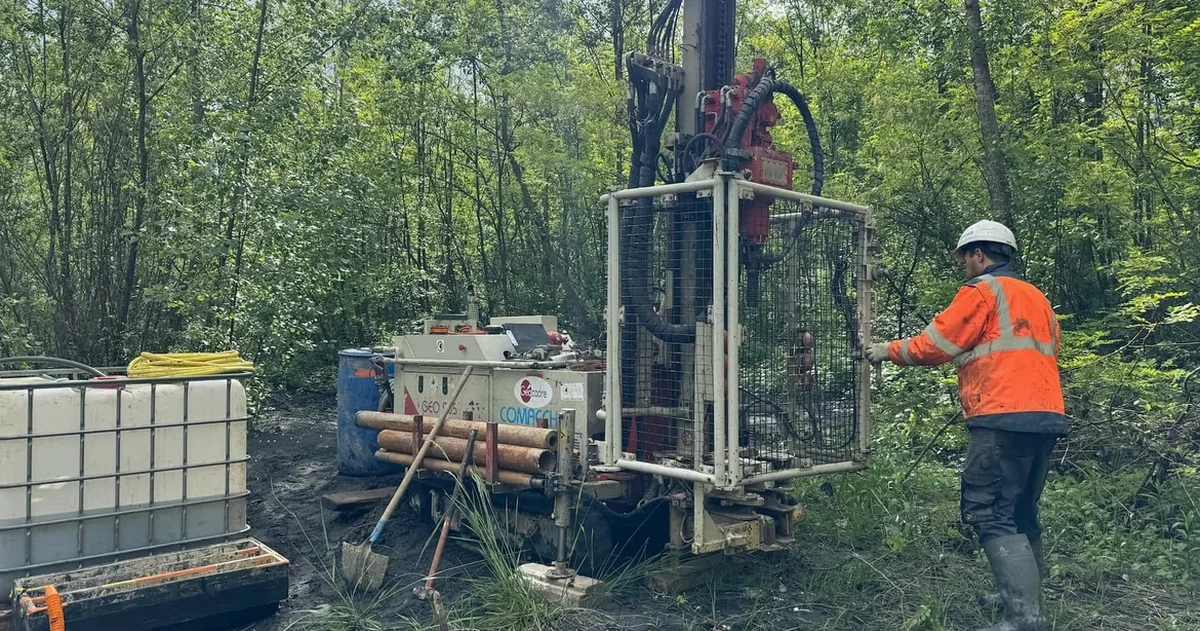
A percussion drilling rig mounted on a tracked carrier begins coring through the dense upper crust of Belfast's urban fill, the hollow thud of the hammer echoing off red-brick Victorian warehouses near the Lagan. The crew logs each change in stratum as the sampler transitions from made ground into the compressible estuarine clays—known locally as Belfast Sleech—that underlie much of the city centre. A soil mechanics study under BS 5930:2015 and Eurocode 7 (BS EN 1997-2:2007) translates these physical samples into design parameters: undrained shear strength, compressibility, and consolidation behaviour that govern how any structure will settle. Because Belfast sits at the head of a drowned river valley where soft post-glacial deposits reach thicknesses of 15 metres or more, the CPT testing provides a near-continuous profile of tip resistance and pore pressure, while triaxial testing in the laboratory determines effective stress strength for deeper foundation elements.
Belfast Sleech can exhibit undrained shear strengths below 20 kPa, demanding rigorous sampling and laboratory testing to prevent excessive differential settlement under structural loads.