GEOTECHNICAL ENGINEERING
BELFAST
HomeSeismicBase isolation seismic design

Base Isolation Seismic Design in Belfast: Low-Seismicity Resilience for Soft Ground

Sound ground. Sound decisions.

LEARN MORE

Belfast sits on a complex patchwork of soft estuarine clays, glacial tills, and the Sherwood Sandstone beneath the Lagan Valley. While Northern Ireland isn't a high-seismicity zone, the 1984 Lleyn Peninsula earthquake (magnitude 5.4) was felt distinctly across the city, and long-period ground motion from distant events can still affect taller structures on weak soil. In our experience, base isolation seismic design here is about managing two things at once: the low but real distant seismic threat, and the ever-present settlement problems of the Belfast Sleech. The soft alluvial clays along the River Lagan amplify ground motion differently than the stiffer till on the hills around Cavehill, so a one-size-fits-all approach doesn't work. We apply BS EN 1998-1:2004 in coordination with site-specific MASW surveys to get the real Vs30 profile, because generic site class assumptions from a desk study can miss thin soft layers that control the isolation frequency.

The real challenge in Belfast isn't the peak ground acceleration. It's the interplay between long-period motion amplification in the Sleech and ongoing settlement under the isolators.
Our service areas

How we work

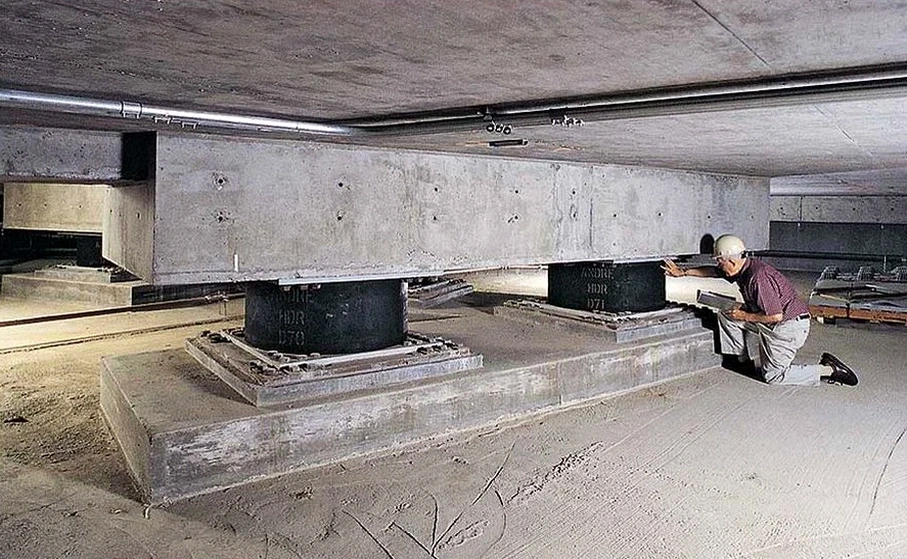
Contrast the dense boulder clay of the Malone Ridge with the compressible estuarine deposits in Titanic Quarter. On the ridge, a conventional fixed-base design might be adequate for wind and vibration, but isolation there still makes sense for vibration-sensitive equipment in labs or hospitals. Down by the docks, where the Belfast Sleech runs 10 to 15 metres deep, the isolation system has to work with piles that already go through consolidating soil. Load transfer becomes critical. The isolators can't just sit on a stiff basement slab if the whole soil column is still settling. We often combine base isolation design with deep foundation analysis using static load tests on piles to verify stiffness under the isolators. The isolator type changes too: lead-rubber bearings on the stiff till for damping, versus high-damping rubber or friction pendulum systems on the softer sites where residual displacement after an event could be a bigger problem. The structural period shift has to clear the 1.5 to 2.5 second range where the soft clay amplifies motion, and that means getting the soil profile right from the start.
Base Isolation Seismic Design in Belfast: Low-Seismicity Resilience for Soft Ground
Technical reference — Belfast

Local ground factors

The equipment that tells the real story in Belfast is the seismic cone penetrometer. When we push a CPTu through the Sleech, we get pore pressure dissipation data that tells us how fast the soil will settle after we load it with a structure on isolators. That consolidation rate matters because the isolator bearings need a stable reference plane to work against. If the ground drops another 40 mm after the isolators are installed, the moat covers and service connections can bind. We've seen cases where differential settlement across a building footprint in the Harbour Estate tilted the isolation plane enough to affect the bearing displacement capacity. The fix isn't just stiffer isolators; it's a ground improvement strategy underneath them. Sometimes that means vibrocompaction or stone columns in the granular layers above the bedrock, executed before the isolator pedestals are cast. The BS EN 1998-5:2004 provisions on foundations in seismic areas guide the allowable bearing pressures, but the settlement under sustained gravity load is what keeps you up at night on these sites.

Need a geotechnical assessment?

Reply within 24h.

Email: contact@geotechnical-engineering.biz

Relevant standards

BS EN 1998-1:2004 – Design of structures for earthquake resistance, BS EN 15129:2018 – Anti-seismic devices, BS EN 1997-1:2004 – Geotechnical design (Eurocode 7), BS 5930:2015 – Code of practice for ground investigations, ICE SPERW – Specification for piling and embedded retaining walls

Typical values

ParameterTypical value
Design code appliedBS EN 1998-1:2004 + UK National Annex
Typical target isolation period2.0 – 3.5 s (soft clay sites)
Seismic hazard referenceBritish Geological Survey seismic hazard maps
Sleech undrained shear strength15 – 40 kPa (design range)
Common isolator types specifiedHDRB, LRB, FPS per EN 15129
Site class determinationMASW Vs30 profiling to BS EN 1998-1 §3.1.2
Pile stiffness verificationStatic load test to ICE SPERW
Settlement analysis basisCoupled consolidation model (Plaxis 2D/3D)

Frequently asked questions

Does Belfast really need seismic isolation if the earthquake risk is low?

It depends on the structure and the ground. For ordinary housing on stiff till, probably not. But for a hospital, data centre, or long-span bridge on the Sleech, isolation provides resilience against rare distant events and also reduces vibration during normal operation. The cost-benefit analysis under BS EN 1998-1 often favours isolation when the alternative is heavy pile caps and deep shear walls to manage the soft soil amplification.

How much does a base isolation design study cost in Belfast?

A full design package, including the geotechnical investigation, response spectra development, isolator selection, and non-linear analysis, typically falls in the range of £3,340 to £5,810 depending on the building footprint and soil complexity. The ground investigation scope is usually the biggest cost driver on soft Belfast sites.

Can you retrofit base isolation to an existing structure in Belfast?

Retrofit isolation is feasible but demanding. The building has to be temporarily supported while the isolation plane is cut into the columns or walls, and the existing foundations must be assessed for the changed load path. In the Titanic Quarter, where many older industrial buildings sit on timber piles through the Sleech, the foundation assessment often determines whether retrofit isolation is viable or if a strengthening approach makes more sense.

What site investigation is needed before designing an isolation system?

At minimum, we need a MASW survey to get the shear wave velocity profile down to bedrock, several CPTu soundings with pore pressure dissipation tests through the Sleech, and laboratory cyclic triaxial or resonant column tests on undisturbed samples. The BS EN 1998-1 site class depends directly on the Vs30 value, and on soft Belfast sites that often places you in Class D or E, which drives the isolation period and displacement demand.

Location and service area

We serve projects across Belfast and surrounding areas.

View larger map