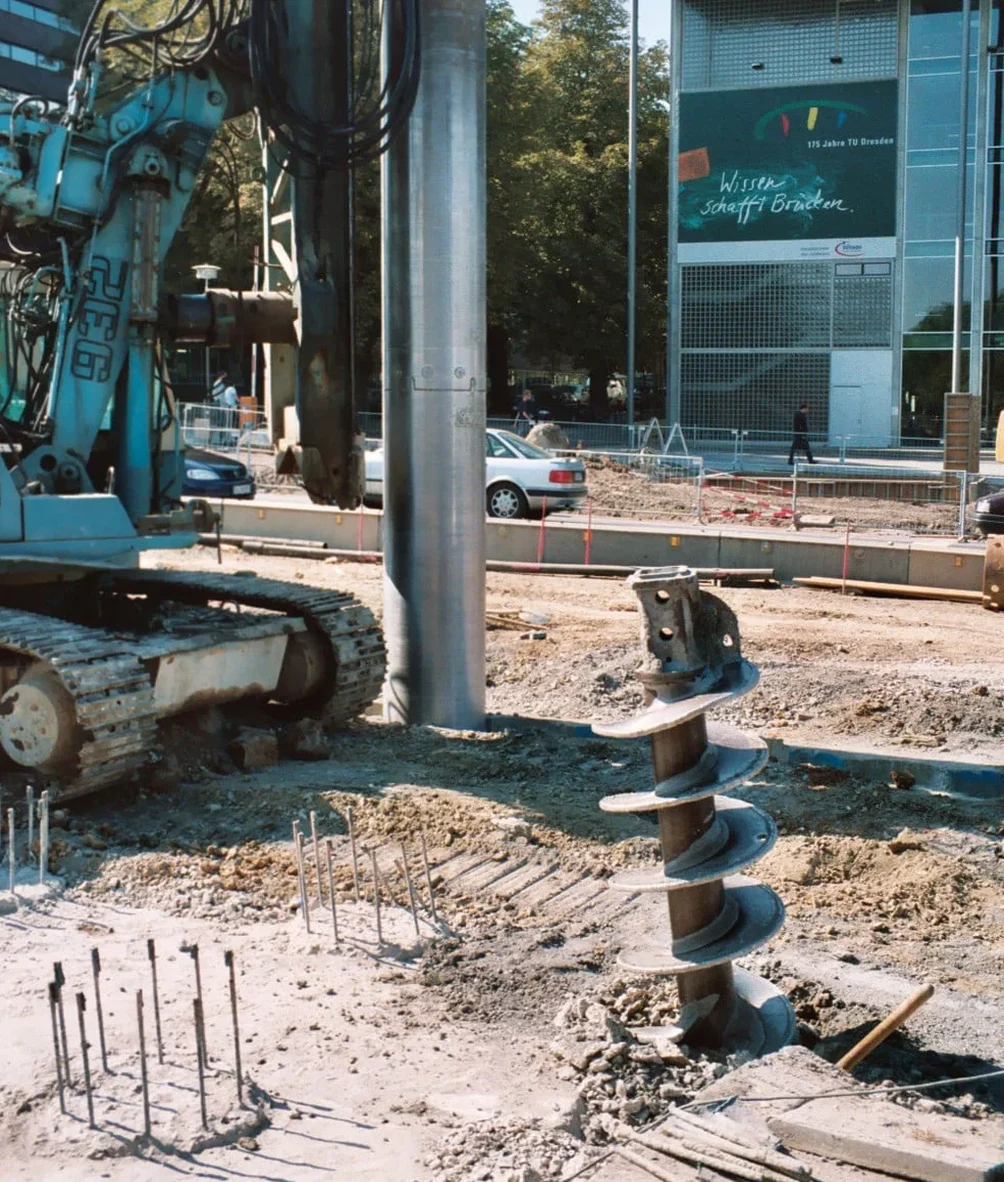
Foundations in Belfast must contend with the complex glacial till and soft alluvial clays that overlie the Triassic sandstone bedrock, particularly within the Lagan Valley. Adhering to Eurocode 7 and local guidance on shrinkable clays is non-negotiable for long-term stability. This category addresses the critical early-stage decisions, from interpreting site investigation data to selecting a robust strategy, often leading to deep solutions like pile foundation design where near-surface bearing capacity is inadequate.
Residential extensions on boulder clay and city-centre commercial developments on reclaimed land both demand a tailored approach to mitigate differential settlement. The high water table in many postcodes frequently necessitates integrated piling and rigorous groundwater control during construction. For sites with a history of industrial use, combining these techniques with targeted contamination remediation is fundamental to delivering a safe and insurable substructure.
BS 8081:2015 – Code of practice for grouted anchors, BS EN 1997-1:2004 – Eurocode 7: Geotechnical design, BS 5930:2015 – Code of practice for ground investigations, CIRIA C760 – Guidance on embedded retaining wall design
An active anchor is prestressed after installation, applying a known force to the structure immediately; it controls movement from the outset. A passive anchor — typical of soil nails — only develops resistance as the ground deforms. In Belfast, we favour active anchors for deep excavations adjacent to sensitive structures, because the prestress limits lateral displacement in a way that passive systems cannot guarantee during the early stages of excavation.
Design and testing packages for a single anchor system in Belfast range from £810 for a straightforward temporary anchor with a single suitability test, up to £2.830 for a permanent anchor requiring full corrosion protection, post-grouting, and a complete suite of investigation and proof load tests. The final figure depends on the number of anchors, the ground conditions encountered, and the testing regime specified.
Much of central Belfast — particularly the shipyard areas and the Lagan corridor — sits on made ground containing industrial fill with variable pH and the presence of sulphates. Combined with the high groundwater table, this creates an aggressive environment for steel tendons. Permanent anchors without Class I double-barrier protection can experience section loss within a decade, compromising the long-term stability of the retained structure.
This service complements our laboratory testing work for a complete project analysis.