GEOTECHNICAL ENGINEERING
BELFAST
HomeGround improvementStone column design

Stone Column Design in Belfast: Ground Improvement on Soft Estuarine Soils

Sound ground. Sound decisions.

LEARN MORE

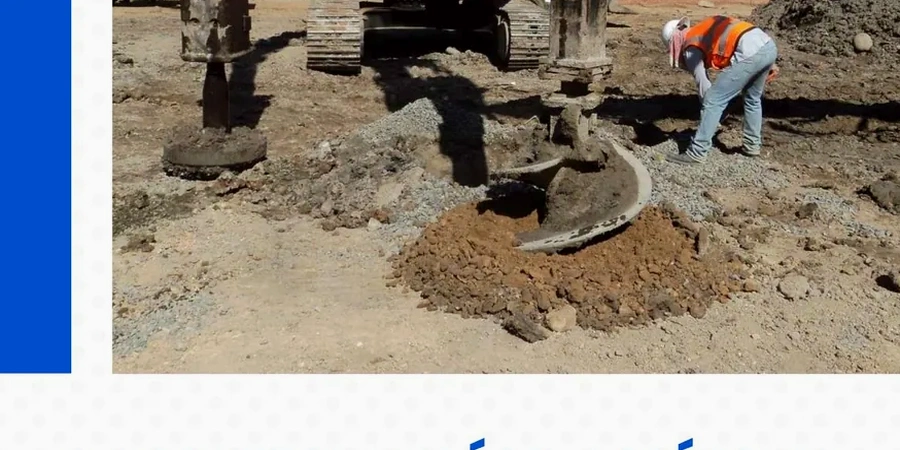
The ground conditions beneath the Titanic Quarter and the Lagan riverfront couldn't be more different from the glacial till that sits under the Antrim Road. On the east bank you're dealing with 15 to 20 metres of soft, compressible estuarine clays — the infamous Belfast 'sleech' — before you reach anything competent. That contrast means a standard pad footing that works perfectly in North Belfast becomes a settlement disaster waiting to happen just two miles south. Stone column design steps in precisely where conventional foundations stop making economic sense, transforming that weak silty clay into a composite ground mass that can handle structural loads without excessive deformation. When a developer near Clarendon Dock rang us last year, the borehole logs looked grim — but the solution didn't require piling. We modelled the column grid, ran the settlement analysis under service loads, and the numbers worked. That's the difference between understanding local geology and just applying a generic ground improvement spec you downloaded from somewhere sunny and sandy.

A well-designed stone column grid in Belfast's sleech can cut settlement by 60% compared to untreated ground — without the steel and concrete bill of a piled raft.
Our service areas

How we work

The superficial geology across central Belfast is dominated by the Late Glacial and post-glacial deposits of the Lagan Valley, where soft alluvial silts and clays reach depths of up to 20 metres. These materials typically show undrained shear strengths below 30 kPa and sensitivity ratios that make them vulnerable to disturbance during installation. A test pit investigation through the made ground layer often reveals the transition from stiff desiccated crust to the softer material beneath — critical information for determining the right column length and diameter. Stone column design here relies on Priebe's method or finite element modelling calibrated to laboratory consolidation and triaxial data, with the installation method — usually bottom-feed vibro-replacement — selected to avoid collapse of the borehole in the soft clay. The column spacing, typically between 1.5 and 2.5 metres on a triangular grid, is adjusted to achieve an improvement factor that brings total settlements within the project's tolerance, often under 25 mm for lightly loaded slabs. In the city centre, where adjacent structures are old masonry buildings with shallow foundations, vibration monitoring becomes mandatory, and we often recommend a vibrocompaction trial in a sacrificial zone before the main production run to confirm that the design energy input won't damage the neighbour's brickwork.
Stone Column Design in Belfast: Ground Improvement on Soft Estuarine Soils
Technical reference — Belfast

Local ground factors

The classic mistake we see on Belfast sites is the assumption that a quick vibro-stone column installation can be designed from a desk study alone, without proper site-specific laboratory testing. A contractor quotes a rate per linear metre based on assumed column lengths, then the rig hits a buried peat lens at eight metres depth — material that wasn't flagged in the historical borehole logs from the 1980s. The column bulges, the gravel takes far more than the theoretical volume, and suddenly the settlement performance is nowhere near what the simple Priebe spreadsheet promised. Peat is compressible, it's laterally weak, and it doesn't confine the stone column the way a soft clay does. The design then needs a complete rethink: longer columns, closer spacing, perhaps a load transfer platform, or even switching to rigid inclusions. Secondary compression in organic soils can extend over years, so skipping the triaxial testing and atterberg limits on the soft strata — to get real effective stress parameters and plasticity data — is a shortcut that costs far more in remedial work than it saves on the front end. A design backed by soil-specific parameters, not generic assumptions, is the only way to make the Eurocode 7 serviceability limit state check meaningful.

Need a geotechnical assessment?

Reply within 24h.

Email: contact@geotechnical-engineering.biz

Relevant standards

BS EN 1997-1:2004 (Eurocode 7) – Geotechnical design, including Design Approach 1 for UK practice, BS 5930:2015 – Code of practice for ground investigations, BS EN 14731:2005 – Execution of special geotechnical work: Ground treatment by deep vibration, ICE Specification for Ground Treatment (2012) – best-practice guidance for vibro stone columns

Typical values

ParameterTypical value
Typical column diameter600 – 1,200 mm
Column spacing (triangular grid)1.5 – 2.5 m
Replacement ratio10% – 35%
Target improvement factor (n)2.0 – 4.0
Post-treatment settlement (service load)≤ 25 mm
Allowable bearing capacity after treatment100 – 250 kPa
Installation depth capacityUp to 25 m (vibro-replacement)
Gravel specification (BS EN 13242)Angular, clean, 20–75 mm

Frequently asked questions

How much does a stone column design package cost for a typical Belfast site?

For a standard commercial or light industrial site in Belfast, a full stone column design package — covering ground model development, settlement analysis, column grid layout, installation specification, and post-treatment verification planning — generally falls between £1,270 and £3,640. The final figure depends on the size of the treated area, the complexity of the ground conditions, and whether finite element modelling is needed beyond the standard Priebe method. Sites with peat layers or highly variable stratigraphy tend toward the upper end because the design requires more iterations and sensitivity checks.

What ground conditions in Belfast make stone columns a better choice than piling?

Stone columns work best where the soft compressible layer — typically the estuarine clays of the Lagan Valley — is between 4 and 15 metres thick and the structure can tolerate some settlement, usually up to 25 or 30 millimetres. If the soft ground goes deeper than about 20 metres, or if the loads are heavily concentrated, piling may be more appropriate. The advantage in Belfast is that stone columns can often support a ground-bearing slab directly, eliminating the need for suspended floor construction, which saves money and programme time. They also provide drainage paths that accelerate consolidation, which is helpful on sites where post-construction settlement needs to happen quickly.

Do I need a ground investigation before a stone column design can be done?

Absolutely. A stone column design without proper ground investigation data is just guesswork. You need boreholes with SPT values, undisturbed samples for triaxial and oedometer testing, and ideally some CPT profiles to map the soft layer thickness and tip resistance continuously. Without that, the designer cannot determine the column length, the improvement factor, or even whether the ground is treatable by vibro-replacement in the first place. On Belfast sites with made ground and variable alluvial deposits, at least two properly logged boreholes are the minimum starting point.

Location and service area

We serve projects across Belfast and surrounding areas.

View larger map