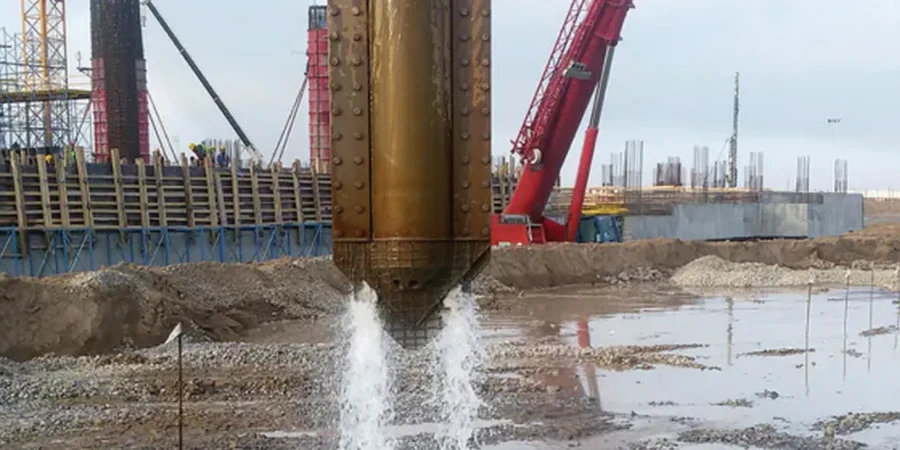
Belfast's nineteenth-century expansion onto the Lagan Valley's soft estuarine clays and its twentieth-century reclamation of the docks created a patchwork of fill and natural deposits that still challenges foundation engineering today. The city centre, from Donegall Square to the Titanic Quarter, sits on up to 12 metres of compressible alluvium overlying glacial till. When a warehouse extension near Duncrue Street showed loose granular fill to 6 metres, the vibrocompaction design had to target a relative density above 70% without disturbing adjacent quay walls. Our laboratory runs Proctor and grain-size curves from site investigation samples before we define grid spacing, probe type and backfill specification. Triaxial testing on compacted specimens confirms the strength gain under the design confining pressure, and CPT logging before and after treatment verifies that the target cone resistance has been reached across the full depth of the loose zone.
On a Belfast quayside project, post-compaction CPT showed a jump in tip resistance from 4 MPa to 11 MPa across the full depth of the loose fill, confirming compliance with the 70% relative density target.