GEOTECHNICAL ENGINEERING
BELFAST
HomeLaboratoryLaboratory CBR test

Laboratory CBR Testing in Belfast: Geotechnical Design for Subgrade and Pavement

Sound ground. Sound decisions.

LEARN MORE

Belfast's urban fabric has expanded dramatically since the Victorian red-brick expansion of the 1880s, pushing infrastructure onto the city's complex glacial till and the soft estuarine clays that line the River Lagan. This historical layering means that subgrade performance can shift dramatically within a single site, and relying on assumed bearing values for pavement design is a risk that no project can afford. Our laboratory CBR test provides the precise, repeatable soaked and unsoaked strength parameters required under the Design Manual for Roads and Bridges. For projects in areas like Titanic Quarter or the outer business parks where heavy-duty pavements must withstand constant logistics traffic, we often pair the CBR with a site-specific Proctor assessment to ensure the specified compaction is actually achievable with the material on site.

A CBR value obtained on a compacted sample at field moisture after a 4-day soak is the single most reliable predictor of long-term subgrade rutting in Belfast's saturated glacial tills.
Our service areas

How we work

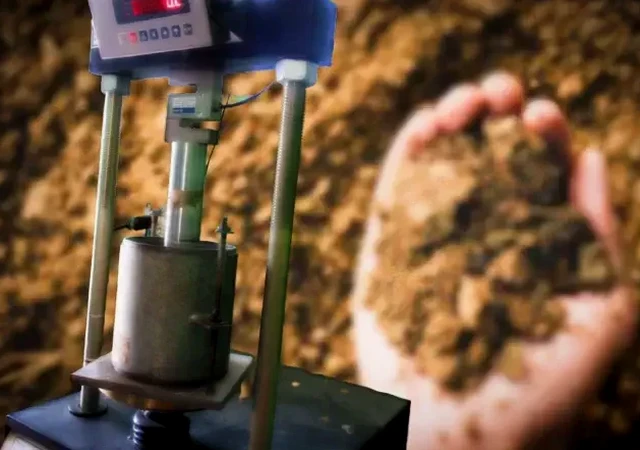
The superficial geology beneath Belfast is dominated by the Belfast Upper Boulder Clay, a stiff, stony diamict whose fines content can range from 15% to over 50%, creating significant variability in drainage and strength when remoulded. Near the Lagan and Blackstaff catchments, these tills are overlain by up to 8 metres of soft, compressible alluvial silts where the water table sits within a metre of the surface. The laboratory CBR test cuts through this heterogeneity by compacting samples at their anticipated field moisture content and subjecting them to a 4-day soak, replicating the worst-case post-construction saturation that drives long-term pavement rutting. We run the test to BS 1377-4:1990 using a motorised penetration frame with a 50 kN load cell and a 49.6 mm diameter plunger advancing at 1.27 mm/min, recording force-penetration curves up to 7.5 mm. Where the design requires a direct comparison with in-situ conditions, we also reference data from our field CBR and DCP campaigns, creating a calibrated link between the laboratory value and the actual layered performance of the subgrade.
Laboratory CBR Testing in Belfast: Geotechnical Design for Subgrade and Pavement
Technical reference — Belfast

Local ground factors

With an average annual rainfall exceeding 900 mm in the Belfast area and a shallow groundwater table across much of the city centre, the soaked CBR value is not an academic exercise—it is the governing condition for pavement life. A subgrade that posts a CBR of 12% at its in-situ moisture can collapse to below 3% after saturation, turning a 30-year flexible pavement design into a maintenance liability within five seasons. This is particularly acute in the Harbour Estate and along the M2 corridor, where the combination of heavy commercial axle loads and waterlogged tills demands a design CBR that has been verified in the laboratory, not inferred from a particle size curve. Our reports flag any swell exceeding 2.5% as a separate risk item, because in Belfast's stiffer clays, differential heave can crack a rigid pavement slab just as effectively as a bearing failure.

Need a geotechnical assessment?

Reply within 24h.

Email: contact@geotechnical-engineering.biz

Watch the video

Relevant standards

BS 1377-4:1990 — Soaked CBR for fine and coarse soils, HD 25/94 (DMRB Vol 7, Section 2, Part 2) — Pavement foundation design, BS EN 13286-47:2021 — CBR for unbound and hydraulically bound mixtures, CD 225 — Design for new pavement foundations (replaces IAN 73/06)

Typical values

ParameterTypical value
Test standardBS 1377-4:1990, BS EN 13286-47
Sample preparation methodStatic or dynamic compaction to target dry density
Plunger diameter49.6 mm (standard penetration piston)
Penetration rate1.27 mm/min
Soaking period96 hours under 4.5 kg surcharge rings
Swell measurementDial gauge reading to 0.01 mm during soak
Reporting units% CBR at 2.5 mm and 5.0 mm penetration

Frequently asked questions

What is the difference between a laboratory CBR and a field CBR test?

A laboratory CBR is performed on a sample compacted into a standard mould under controlled conditions, usually after a 4-day soak to simulate long-term saturation. A field CBR, by contrast, is measured in-situ using a plunger or a Dynamic Cone Penetrometer on the undisturbed ground. The lab test gives the design value for pavement thickness; the field test verifies that the constructed subgrade actually meets that design. In Belfast, where the groundwater rises quickly in winter, the soaked lab CBR is often the more conservative and governing value.

How much does a laboratory CBR test cost in Belfast?

A single-point soaked CBR test to BS 1377-4 typically falls between £110 and £170, depending on whether it includes moisture content determination, Proctor correlation, and a full swell log. A full pavement investigation suite with three CBR points, grading and plasticity tests for a typical commercial development in Belfast runs from £450 to £700.

Why is a 4-day soak necessary for the CBR test?

The 96-hour soak under a surcharge load models the worst moisture condition the subgrade will experience during its service life. In Belfast, where the water table is often less than 1.5 metres below ground level, a subgrade that tests well at its natural moisture content can lose over 60% of its bearing capacity once it reaches saturation. The soaked CBR value is the one used in the pavement design catalogue in HD 25/94.

Can the laboratory CBR test be used for granular materials and recycled aggregates?

Yes, but the method differs slightly. For coarse granular materials and crushed concrete aggregates, we follow BS EN 13286-47, which uses a larger mould and a modified compaction effort. These materials typically produce CBR values above 30% and are used as Type 1 sub-base in Belfast's heavy-duty pavements. The test confirms the material meets the specifications in the SHW Series 800 before it is placed on site.

What CBR value is considered acceptable for a residential road in Northern Ireland?

Under the guidance of CD 225 and the regional road authority, a subgrade CBR of at least 5% is generally required for a flexible residential pavement with light traffic. If the laboratory CBR falls below 2.5%, the standard pavement design requires either a capping layer of at least 350 mm or a stabilised subgrade. In Belfast's softer alluvial areas near the Lagan, we frequently see values between 1.8% and 3.2%, which triggers a capping layer requirement in the design.

Location and service area

We serve projects across Belfast and surrounding areas.

View larger map