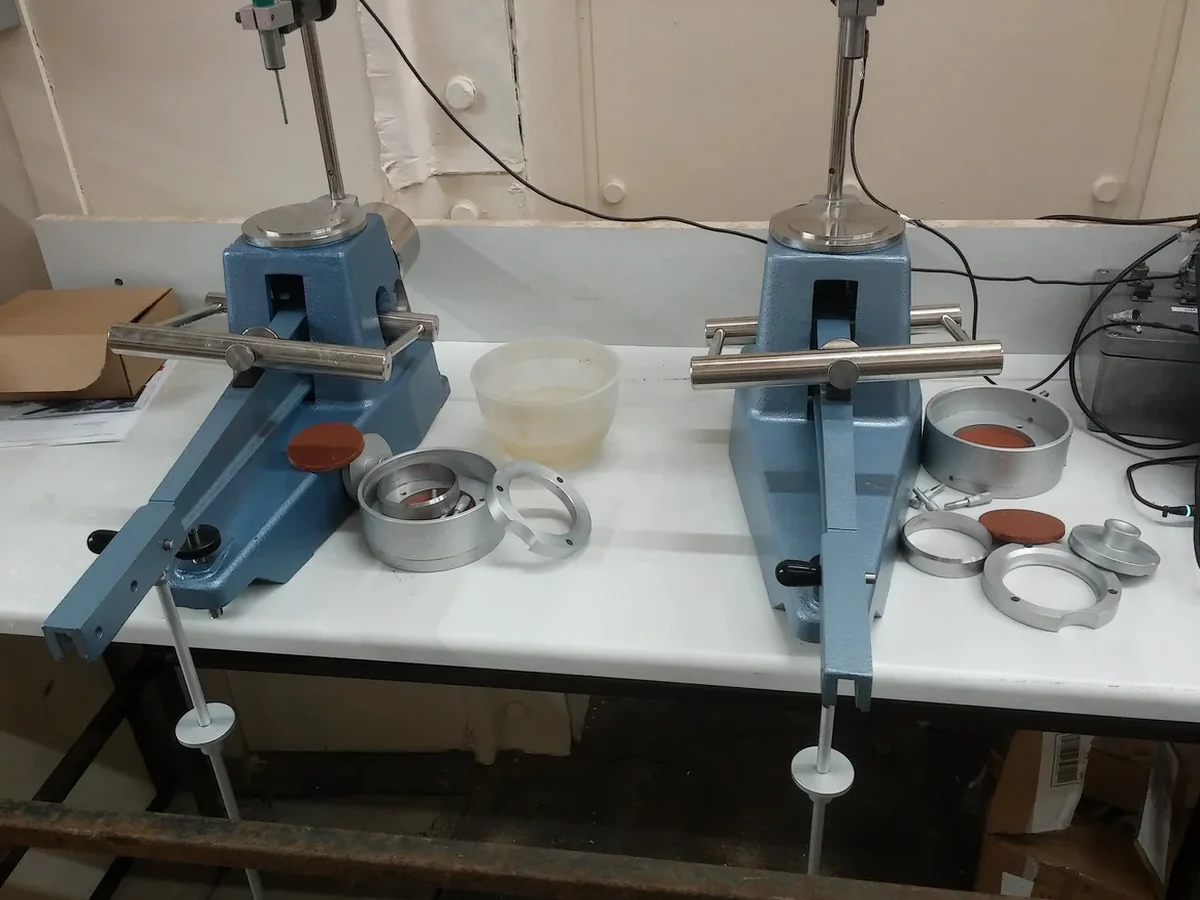
Belfast sits atop a complex glacial legacy where the underlying geology shifts rapidly from the Triassic Sherwood Sandstone of the Lagan Valley to the lodgement tills and late-glacial clays that mantle the drumlin swarms across the city. These cohesive deposits, particularly the Belfast Upper Till, often contain high proportions of silt and clay-sized particles that govern how the ground responds to water content changes. For any foundation excavation, road subgrade, or embankment in the greater Belfast area, classifying these fine-grained soils through Atterberg limits testing is not an academic exercise — it is the primary method for predicting volumetric stability and long-term performance under loading. We run these determinations in our accredited laboratory to BS 1377-2:1990 standards, delivering the liquid limit, plastic limit, and plasticity index that structural and geotechnical engineers need to calibrate bearing capacity assumptions and drainage design.
Moisture content boundaries define whether a Belfast glacial till will support a spread footing or require removal and replacement before the first floor slab is poured.