GEOTECHNICAL ENGINEERING
BELFAST
HomeInvestigationSPT (Standard Penetration Test)

Standard Penetration Test (SPT) in Belfast – Site Investigation That Saves Rework

Sound ground. Sound decisions.

LEARN MORE

Most people don't realise that Belfast sits on a patchwork of glacial till, soft alluvial clays along the Lagan, and historic fill from the city's industrial past. You can have firm gravel at one end of a site and compressible silt at the other. That's why the Standard Penetration Test still earns its keep here. It gives you a number—the N-value—that cuts through the guesswork and tells you straight away whether the ground can handle a shallow foundation or if you'll need to look at something deeper. We run the test to BS 5930 and combine it with test pits where the upper layers need visual inspection, and with CPT when the profile calls for continuous data in softer materials. For a city with as much buried history as Belfast, you want more than one line of evidence before you commit to a foundation design.

An SPT N-value below 4 in Belfast's estuarine clays isn't a minor detail—it's the difference between a standard strip footing and a piled solution that adds weeks to your programme.
Our service areas

How we work

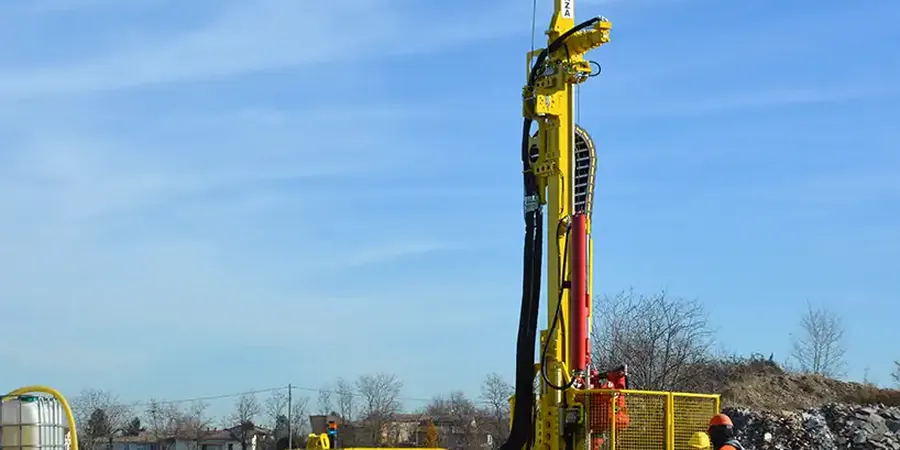
Belfast's postcode BT3 alone has seen over £500 million in regeneration investment in the last decade, and a fair chunk of that has gone into sites where the ground conditions were anything but straightforward. The SPT test we run uses a 63.5 kg hammer dropping 760 mm, driving a split-spoon sampler in 150 mm increments, and recording the blow count for each 300 mm of penetration. That sounds simple on paper, but the value is in knowing when to stop and interpret. In the dense glacial till you find across the Castlereagh hills, refusal above 50 blows is common and tells you that a shallow footing might be more economical than piling. Down by the docks, where the fill can be 4 metres thick over estuarine silt, N-values in the single digits are the norm and you're straight into considering settlement mitigation. Our rigs are compact enough for back-garden extensions in BT9 and solid enough for commercial plots in Titanic Quarter, so we don't have to turn down work because of access.
Standard Penetration Test (SPT) in Belfast – Site Investigation That Saves Rework
Technical reference — Belfast

Local ground factors

The mistake we see too often in Belfast is treating the whole site like it's one soil type. A contractor takes a few SPT readings in the south-east corner, gets decent N-values in the till, and assumes the rest will follow. Then the excavator hits a pocket of made ground full of brick rubble and old dock timber, and suddenly the foundation design doesn't work. That's when the phone call comes—usually on a Friday afternoon, with concrete scheduled for Monday. The SPT isn't expensive compared to the cost of redesigning footings mid-construction or, worse, dealing with differential settlement two years after handover. Spacing your boreholes properly and going deep enough to catch what's underneath the fill is the kind of discipline that separates a reliable ground investigation from a box-ticking exercise. Belfast's subsurface doesn't do uniformity, and your investigation shouldn't pretend otherwise.

Need a geotechnical assessment?

Reply within 24h.

Email: contact@geotechnical-engineering.biz

Relevant standards

BS 5930:2015 + A1:2020, BS EN ISO 22476-3:2005, Eurocode 7 (BS EN 1997-2:2007)

Typical values

ParameterTypical value
Hammer typeAutomatic trip hammer, 63.5 kg
Drop height760 mm (BS EN ISO 22476-3)
SamplerStandard split-spoon (35 mm ID, 50 mm OD)
Test intervalsTypically 1.5 m or at stratum change
Standard referenceBS 5930:2015 + A1:2020
Reporting metricN-value (blows/300 mm), N₆₀ corrected on request
Typical depth range1.5 m to 30 m bgl with dynamic sampling

Frequently asked questions

How much does an SPT investigation cost for a typical Belfast residential plot?

For a standard residential project—say a house extension or a single new-build on a plot up to 400 m²—you're looking at £370 to £590 for the SPT element, depending on access, number of boreholes, and depth. The final figure depends on whether we can get the rig into the garden without dismantling a fence, and whether you need lab testing on top. We'll give you a fixed price before we mobilise, not an estimate that drifts.

How deep do you need to go with SPT boreholes in Belfast?

It depends entirely on what's underneath and what you're building. For a two-storey extension on glacial till in the Castlereagh area, 6 to 10 metres below ground level is usually enough to satisfy building control. On the alluvial soils near the Lagan, we'll often go to 15 metres or until we hit competent material, whichever comes first. The key is reaching a stratum that can carry the load without excessive settlement, and we make that call based on the N-values as we drill.

How quickly can I get the SPT results after you finish on site?

We typically issue the factual report with borehole logs, N-values, and soil descriptions within three to five working days of completing fieldwork. If you need interpreted parameters—bearing capacity, settlement estimates, pile recommendations—that adds a few more days depending on complexity. For urgent jobs in Belfast, we've turned around same-week reports when the project programme depends on it.

Location and service area

We serve projects across Belfast and surrounding areas.

View larger map