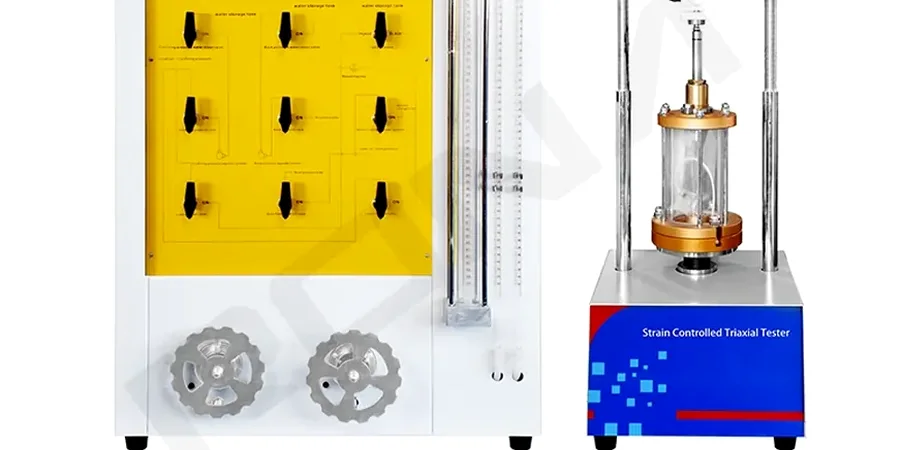
A common mistake on Belfast sites is specifying foundation bearing pressures based on SPT N-values alone, without understanding how the soil behaves under long-term drained loading. The city’s complex glacial legacy produces stiff lodgement tills that look competent in the split spoon but can soften dramatically at the critical state. We run consolidated-undrained triaxial tests with pore pressure measurement on Shelby tube samples extracted from the Boulder Clay, following BS 1377-7:1990. In East Belfast, where the Mercia Mudstone Group weathers to a stiff clay near the surface, effective stress parameters from a triaxial test are the only reliable way to design retaining structures that won’t creep over a 50-year design life. For projects investigating seismic response of soft estuarine silts near the Lagan, a complementary CPT test provides continuous stratigraphy before selecting the sampling depths for triaxial specimens.
Effective stress parameters from a drained triaxial test on Belfast till typically reduce the required foundation width by 15 to 25 percent compared to conservative total stress assumptions.